Monday, July 7, 2014

This Week on the Celtic Calendar: Ordinary Time

Ordinary time. It's that season on the church calendar between Pentecost and Advent when nothing much is going on. No feasting or fasting. No preparation or celebration. Liturgical life is just . . . ordinary.  

Daily life, however, is another story. Rarely are our lives just ordinary. The human condition seems to swing back and forth between activity and rest, strife and peace, sorrow and joy. It's a rhythm we see mirrored in the landscape around us, in the turning of the seasons, in the turning of the tide.

Perhaps that's why the concept of ebb and flow features so strongly in Celtic spirituality. Nature, that first book of revelation, reminds us that what is ordinary is change, movement.  

The tide comes in, the tide goes out. The lesson for us in ordinary time is to learn to live in the moment and go with the flow.

Monday, June 9, 2014

Today on the Celtic calendar . . . the feast of St. Columba

June 9 is the feast of St. Columba, also known as Columcille or "church dove."  Although most commonly associated with Scotland and the island of Iona, Columba began his life in northern Ireland and spent his first forty plus years in that country.  He studied under St. Finnian at Clonnard Abbey (along with St. Brendan) first becoming a monk and later a priest.   It was another Finnian, Finnian of Movilla, who was the catalyst in Columba's exile from Ireland and subsequent founding of the monastic community on Iona.

Columba was a poet at heart and lover of books.  While at Moville, Columba began secretly copying one of their psalters so he could have a copy of the book for himself.  Finnian discovered Columba's activity and, as books were such a rare and precious commodity, insisted that the copy must stay at Moville with the original text.   In what was probably the first battle over copyright issues, the conflict led to a literal battle in which many men were killed and the Irish proverb, "To every cow its calf, to every book its cop," was spawned.

Columba felt remorse over the deaths that followed his action and as others who had been held accountable were exiled from Ireland, he decided to submit himself to the same punishment.  Taking a dozen monks with him, they set forth in a coracle for a place where Columba could no longer see his beloved Ireland.  The monks first landed on the shores of southern Scotland but could still glimpse the green of Erin across the sea so they traveled farther north until they came to the island of Iona.  Columba spent the remaining decades of his life in Scotland, establishing a monastery on the island and continuing the work started by St. Ninian nearly two hundred years earlier in working among the Picts throughout the west and north of Scotland. 

The community on Iona was not only the heart of Celtic Christianity in Scotland and Northumbria in the sixth century, it also was key in the Celtic revival of the early twentieth century when the Rev. George MacLeod took a community from Glasgow to rebuild the monastery on Iona and established the ecumenical Iona Community that continues to welcome members and friends committed to justice and peace.   

A Prayer Attributed to St. Columba
Be Thou a bright flame before me.
Be Thou a guiding star above me.
Be Thou a smooth path beneath me.
Be Thou a kindly shepherd behind me.
Today and evermore.

Tuesday, May 27, 2014

This week on the Celtic Calendar . . . The Feast of St. Melangell

Now they reached Melangell’s lonely church:
Amid a grove of evergreens it stood,
A garden and a grove, 
where every grave
Was decked with flowers, 
or with unfading plants
O’ergrown,—sad rue 
and funeral rosemary.   
                            ~Robert Southey

May 27 is the fest of St. Melangell.  Despite her popularity in Wales where her story has inspired countless poets, the tale of Melangell and her hare isn't widely known in the rest of the world.  Born in Ireland of royal parentage, like so many of the women Celtic saints of her era she fled her homeland to escape an arranged marriage and ended up in a secluded valley nestled in the Berwyn mountains where she spent fifteen years living and praying among the creatures of the forest and field and avoiding human contact.  

One day as she was deep in prayer, she heard the distant horns of a hunter and soon a frightened hare, pursued by a pack of hounds, ran into the clearing and under Melangell's skirt, seeking shelter.  Rather than attacking Melangell in order to get to their prey, the hounds were brought up short, stopped by a force field of holiness that emanated from her.  Soon the owner of the dogs, the prince of Powys, rode up on his steed, furious that a
trespasser interrupted his hunt. Brochwell tried to encourage his dogs to go for the hare, but when he blew his hunting horn, it stuck to his lips and didn't make a sound.  After hearing Melangell's story, Brochwell asked her if she'd be willing to accept the surrounding land as a gift and establish an abbey that would offer sanctuary to all who needed it.  Melangell agreed and spent the rest of her long life offering shelter and hospitality to those in need.  

In latter years the church and Melangell's shrine fell into disrepair.  The church and shrine were restored in the 1990s and the St. Melangell Centre was established to offer pastoral support for cancer patients and their loved ones.  In 2003 the Centre expanded their ministry to offer sanctuary to anyone in need by providing space and resources for quiet days, retreats, and educational programs.


Tuesday, May 20, 2014

Maytime in Wales

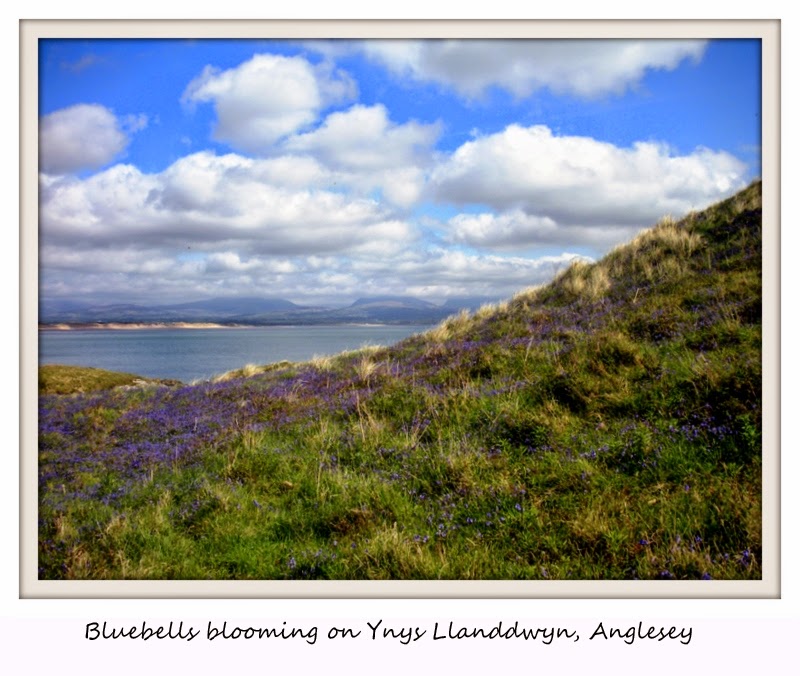
Exactly one year ago a group of 25 pilgrims and I were in northern Wales, a few days into our week long journey exploring the lives, legends and landscapes of the Celtic tradition.  

Here are a few postcards of the sacred places we encountered on our journey.  It's easy to see why the anonymous Welsh poet wrote the following words over 1000 years ago . . .

Maytime is the fairest season,
With its loud bird-song and green trees,
When the plow is in the furrow
And the oxen under the yoke,
When the sea is green,
And the land many colors.


Wednesday, May 14, 2014

This week on the Celtic calendar . . .

May 16 is the feast of Brendan the Navigator, the Irish saint whose wanderlust took him on the travels that made him famous.  Born in the southwest of Ireland in the late fifth century, he studied under St. Ita and was one of the "twelve apostles of Ireland" who were tutored by Finnan of Clonard.  His travels began in earnest after he was ordained a priest and he spent the next several decades sailing around Ireland,before undertaking the journey for which he is known.

Brendan's legendary voyage with a bevy of disciples (14 in some versions 16 in others) to the Isle of the Blessed follows the form of Irish seafaring folk stories of the time where travelers encounter a variety of fantastic characters and scenarios.  One of the Brendan legends intersects the  myth of the Children of Lir, the three sons and one daughter of an Irish king who were turned into swans by their jealous step-mother. The magic destined them to spend 300 years on a lake by their father's castle, 300 years on the Sea of Moyle, and 300 years in the waters near Inish Glora off the coast of County Mayo.  As Brendan stopped by the island, he discovered the swans whom he baptized, turning them back into the humans, albeit 900 year old humans who immediately died.

After returning from his exploration, Brendan continued to sail around the British Isles, studying with St. Gildas in Wales, visiting St. Columba on Iona, and establishing communities in Scotland and Ireland along the way.  He died on terra firma while visiting his sister, Briga, at the community he established for her at Annaghdown although reportedly his remains were buried at Clonfert.

While some scholars doubt the veracity of the Brendan tale, some of his descriptions seem to point to an encounter with real geographic places such as the icebergs in the north Atlantic and the volcanoes of Iceland. In the 1970s British explorer Tim Severin built a replica of Brendan's currach and sailed with a crew from Ireland to Newfoundland.  He chronicled their journey in his book The Brendan Voyage which inspired composer Shaun Davey to write an orchestral suite by the same name.


Tuesday, April 8, 2014

April showers bring . . . pilgrims?

When April with his showers sweet with fruit
The drought of March has pierced unto the root
And bathed each vein with liquor that has power
To generate therein and sire the flower;
When Zephyr also has, with his sweet breath,
Quickened again, in every holt and heath,
The tender shoots and buds, and the young sun
Into the Ram one half his course has run,
And many little birds make melody
That sleep through all the night with open eye
(So Nature pricks them on to ramp and rage)-
Then do folk long to go on pilgrimage,
And palmers to go seeking out strange strands,
To distant shrines well known in sundry lands.
And specially from every shire's end
Of England they to Canterbury wend,
The holy blessed martyr there to seek
Who helped them when they lay so ill and weak.
(from the prologue to The Canterbury Tales by Geoffrey Chaucer, modern translation)

Ah spring!  The time a young(ish) (wo)man's thoughts turn to . . . pilgrimage?  According to Chaucer, April showers bring not only May flowers but also an influx of pilgrims to Canterbury. 

I confess I haven't been to Canterbury . . . yet.  I've been to other English pilgrimage Cathedrals--Winchester (to see the shrines St. Swithun, and of course, Jane Austen); Salisbury and its neighboring pilgrimage attraction, Stonehenge; and most recently, Chester Cathedral. 

Chester, sitting on the northwest English border, is the place where I begin the northern Wales pilgrimages I lead, following in the footsteps of the many pilgrims of old who made their way along the northern pilgrim's path to Bardsey Island. Chester wasn't just a starting point for pilgrimages into Wales however.  The town  has its own saint who brought pilgrims to the area:  St. Werburgh, an Anglo-Saxon princess, became the patron of Chester after her remains were interred in the Benedictine abbey cum cathedral in the late eleventh century.  Her shrine  is still visited by pilgrim's today but it's to the chapel adjacent to her dimly lit stone monument to which I make a pilgrimage whenever I visit Chester Cathedral.  

The Martyrdom of Becket Boss at Chester Cathedral
For high up on the ceiling there's a remarkable carving that is overlooked by many visitors.  In 538 Henry VIII, who was engaged in a bit of a power struggle with the church, decided to try Britain's beloved saint, Thomas Becket, for treason. Unfortunately Thomas, who had been dead for nearly 500 years, was otherwise occupied and didn't appear at the trial.  The court found him guilty in absentia,  his relics and shrine at Canterbury were carted away, and Henry ordered the destruction of any and all iconography related to Becket throughout the rest of England.

Fortunately for Chester, by the time Henry's henchmen reached the north of England they must have had stiff necks for they neglected to look up and the image of the martyrdom of Becket was spared.  The abbot of Chester was also spared during the dissolution of the monasteries after choosing to renounce Rome rather than staying faithful to the Catholic church and losing his head in the process.  He was allowed to become a Protestant priest and was made the first dean of the abbey turned Cathedral at Chester.

Although I don't know anything else about Thomas Clarke, that former abbot/first dean, I like to imagine him walking to the rear of the cathedral and slipping into the chapel every now and again, glancing up at the ceiling with a sly smile and giving a brief nod to that image of Becket, one survivor acknowledging another.