Showing posts with label pilgrimage. Show all posts

Friday, September 7, 2018

North American Festival of Wales

This past weekend I had the privilege to speak on pilgrimage places in Wales at the North American Festival of Wales. Wales has a rich history as a place of pilgrimage, long before the first Christians ever arrived or were formed in the country.Holy wells, lakes, trees, islands, and standing stones were sacred sites visited for prayer and ritual in the Iron Age and likely before.

Some of these sites have been remembered as they were woven into the Christian story, like Virtuous Well aka St. Anne's well near Trellech.  Others were lost to history and rediscovered through chance, such as Llyn Cerrig Bach on Anglesey Island. Most have probably been lost to us for good.

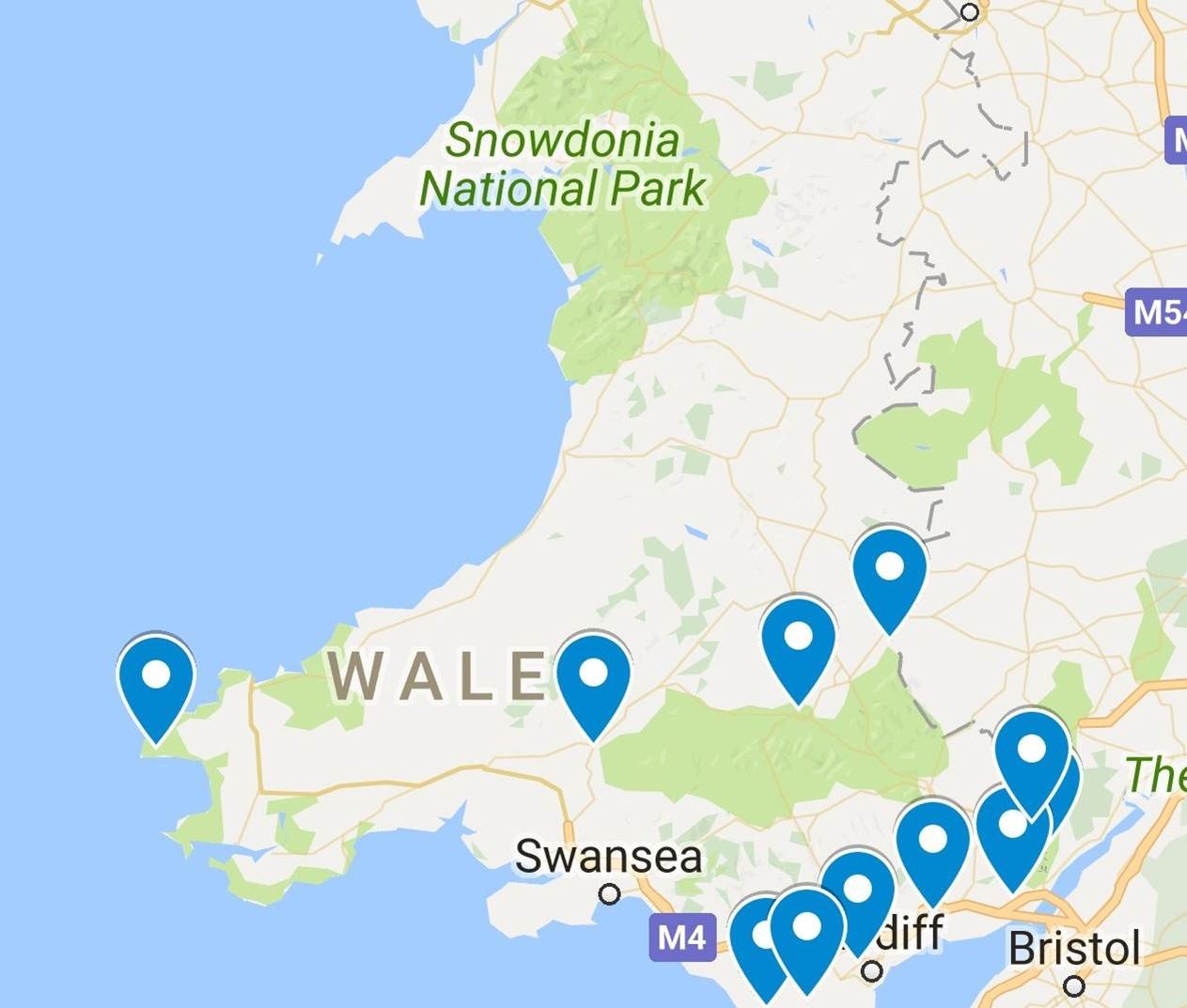
Likewise, there were probably more established pilgrimage routes leading to places such as Bardsey Island and St. David's Cathedral than are remembered.  In 2013, pilgrims from Washington National Cathedral heard about the reclaiming of the North Wales Pilgrim's Way from some of the organizers of that project during the diocese of St. Asaph's "Year of the Pilgrimage" and then went on to visit some of the stops along that route. In my talks on Friday and Saturday, we traced that northern route from Basingerwerk Abbey to Bardsey Island as well as a pilgrimage trail in the south that leads from the Wye Valley along the coast to St. David's Cathedral. Below are a few maps and pictures of some of those sacred sites we virtually visited this weekend. Thank you to all who attended!


North Wales Pilgrim's Way

Basingwerk Abbey

St. Winefride's Well, Holywell


St. Beuno's Church, Clynnog Fawr


South Wales pilgrimage route

Clooties on a hawthorn tree by Virtuous Well


Tintern Abbey
Old Celtic crosses, St. Illtyd's Church


St. David's Cathedral

Tuesday, April 8, 2014

April showers bring . . . pilgrims?

When April with his showers sweet with fruit
The drought of March has pierced unto the root
And bathed each vein with liquor that has power
To generate therein and sire the flower;
When Zephyr also has, with his sweet breath,
Quickened again, in every holt and heath,
The tender shoots and buds, and the young sun
Into the Ram one half his course has run,
And many little birds make melody
That sleep through all the night with open eye
(So Nature pricks them on to ramp and rage)-
Then do folk long to go on pilgrimage,
And palmers to go seeking out strange strands,
To distant shrines well known in sundry lands.
And specially from every shire's end
Of England they to Canterbury wend,
The holy blessed martyr there to seek
Who helped them when they lay so ill and weak.
(from the prologue to The Canterbury Tales by Geoffrey Chaucer, modern translation)

Ah spring!  The time a young(ish) (wo)man's thoughts turn to . . . pilgrimage?  According to Chaucer, April showers bring not only May flowers but also an influx of pilgrims to Canterbury. 

I confess I haven't been to Canterbury . . . yet.  I've been to other English pilgrimage Cathedrals--Winchester (to see the shrines St. Swithun, and of course, Jane Austen); Salisbury and its neighboring pilgrimage attraction, Stonehenge; and most recently, Chester Cathedral. 

Chester, sitting on the northwest English border, is the place where I begin the northern Wales pilgrimages I lead, following in the footsteps of the many pilgrims of old who made their way along the northern pilgrim's path to Bardsey Island. Chester wasn't just a starting point for pilgrimages into Wales however.  The town  has its own saint who brought pilgrims to the area:  St. Werburgh, an Anglo-Saxon princess, became the patron of Chester after her remains were interred in the Benedictine abbey cum cathedral in the late eleventh century.  Her shrine  is still visited by pilgrim's today but it's to the chapel adjacent to her dimly lit stone monument to which I make a pilgrimage whenever I visit Chester Cathedral.  

The Martyrdom of Becket Boss at Chester Cathedral
For high up on the ceiling there's a remarkable carving that is overlooked by many visitors.  In 538 Henry VIII, who was engaged in a bit of a power struggle with the church, decided to try Britain's beloved saint, Thomas Becket, for treason. Unfortunately Thomas, who had been dead for nearly 500 years, was otherwise occupied and didn't appear at the trial.  The court found him guilty in absentia,  his relics and shrine at Canterbury were carted away, and Henry ordered the destruction of any and all iconography related to Becket throughout the rest of England.

Fortunately for Chester, by the time Henry's henchmen reached the north of England they must have had stiff necks for they neglected to look up and the image of the martyrdom of Becket was spared.  The abbot of Chester was also spared during the dissolution of the monasteries after choosing to renounce Rome rather than staying faithful to the Catholic church and losing his head in the process.  He was allowed to become a Protestant priest and was made the first dean of the abbey turned Cathedral at Chester.

Although I don't know anything else about Thomas Clarke, that former abbot/first dean, I like to imagine him walking to the rear of the cathedral and slipping into the chapel every now and again, glancing up at the ceiling with a sly smile and giving a brief nod to that image of Becket, one survivor acknowledging another.  


Monday, March 17, 2014

Welcome to Postcards from the Pilgrim's Path

The Feast of St. Patrick seemed like an auspicious day to begin a new blog about Celtic spirituality.  So for the very first Postcard from the Pilgrim's Path, I offer you a postcard of a path perhaps walked by St. Patrick himself.  
Path leading to Ffynnon Badrig, Patrick's Well
This steep grassy incline is the path leading down to Patrick's cave at Llanbadrig on the northern tip of Anglesey Island. Legend has it that Patrick was shipwrecked along the Welsh coast during a storm on one of his voyages to or from Ireland.  After swimming to shore, he sheltered overnight in the cave at the bottom of this path.  In the morning when the seas and winds had calmed, Patrick climbed up the hill and vowed to build a church on terra firma as a votive offering in thanksgiving for his survival.

When I led a group of pilgrims to Wales last May, two brave souls crawled down the path and entered the cave where they found the fresh water spring that kept Patrick nourished through the night.

Maybe the next time we visit I'll be brave enough to attempt the descent for myself.    And if I do, I'll be sure to call to mind the words of the Breastplate of St. Patrick, especially the invocation for protection against "drowning and wounding" as the seas around Llanbadrig seemed stormy even on a gloriously sunny afternoon.

Llanbadrig Church
The familiar words of St. Patrick's prayer, "I arise today . . . " follow the format of a lorica, a Druidic prayer of protection.  From the Latin word for body armor, these types of prayers were often said in the morning or before the start of a journey.  A lorica wasn’t recited as much to invoke the Spirit, which is always present, rather to remind the one praying of the presence of the Holy that is always with us.  When a lorica was said,   it was customary for those praying to stand and draw a circle around themselves with their index finger to symbolize the encompassing power of protection they were  invoking.

Yet another auspicious reason to be beginning this blog with postcards from Llanbadrig is that, in some small way, this blog is my own votive offering, a symbol of the work of Anam Cara Retreats and my writing and teaching on the Celtic path.  So here I go, tossing my first post into the vast sea of the internet with a prayer of thanksgiving for all who read it.